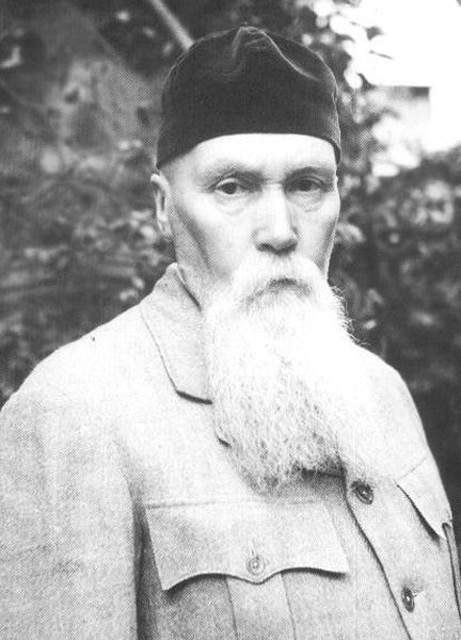
Nicholas Konstantinovich Roerich (1874–1947): painter, archaeologist, writer, traveler and thinker. He left more than seven thousand paintings, now scattered across the world, and countless books, essays and diaries.
He studied at the Imperial Academy of Arts in St. Petersburg and in the same years worked on archaeological excavations. Russian legends and ancient cultures were the first sources of his art. He also worked for the theater: he designed the sets and costumes for Stravinsky's ballet The Rite of Spring (1913).
In the 1920s, together with Helena Roerich, he set out on a great expedition across Central Asia and the Himalayas, following the trail of Shambhala. These journeys became the source of the paintings of his mature period, known for their Himalayan landscapes. He spent the last years of his life in the Kullu valley in India.
For him, peace and culture were inseparable. The Roerich Pact, which aims to protect cultural heritage in time of war, was signed by the nations of the Americas in 1935; its symbol is the Banner of Peace.
Agni Yoga is a teaching introduced to the West in the 1920s by Nicholas and Helena Roerich. Its name means "the path of union with the sacred fire" in Sanskrit. Although its roots reach back to ancient Indian philosophy, it is in essence a way of life practiced in daily life, founded on conscious thought, love, creativity and spiritual energy.
Agni Yoga page →In Our Publications
- Helena – Nicholas RoerichThe life and legacy of the Roerichs.
Other Pages
Master Morya
Master of the first ray; Helena Roerich's teacher and the source of the Agni Yoga books.
Introduction to Agni Yoga
The relation of Agni Yoga to the other yogas and its practice in daily life.
Helena Roerich
Transmitter of the Agni Yoga teaching; her life, letters and legacy.
Lord Agni
The Lord of Fire of the Vedas and the symbol of the mental plane.
Agni Yoga Series
Our translations of Leaves of Morya's Garden and New Era Community.