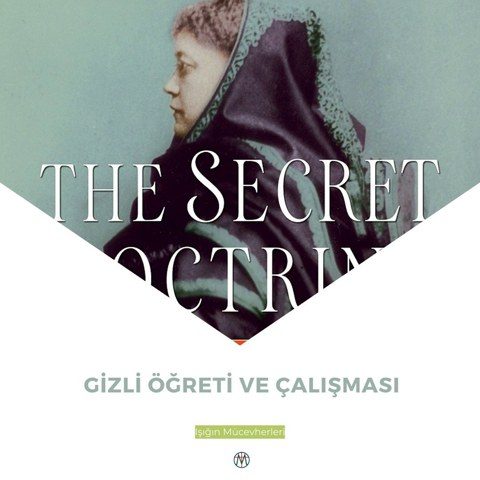
First published in 1888, The Secret Doctrine is the most important work of H. P. Blavatsky, whose writings form the foundation of modern Theosophy. The book sets out in rich detail a vision of the nature of life, the origin and development of the universe, and the evolution and purpose of human existence.
The book also examines how these subjects are treated in ancient religions and in contemporary science. Its title, however, can be misunderstood: the work is not about some dogmas that have been deliberately hidden. The word doctrine in the title means a theory, a way of looking at the world. Theosophy is not a dogmatic or didactic system; it offers a worldview, but says that we should accept only that part of it which appeals to our reason and satisfies our sense of truth. "Secret" means something not generally known but accessible to anyone who makes the effort to discover it: an "open secret." The first of the book's two volumes is titled Cosmogenesis and deals with how a universe comes into being; the second is titled Anthropogenesis and examines the origin of humanity.
Each volume opens with passages from the Stanzas of Dzyan, an ancient poetic text, and commentaries on them. These are followed by a comparison of legends, myths, and the symbols of scriptures, and a discussion of some related scientific ideas.
Studying The Secret Doctrine is a way of understanding ourselves and the world around us with a deeper Theosophical insight. Unless we reflect on the universal wisdom on which the work rests, we are like children playing with the pieces of a jigsaw puzzle without seeing the magnificent pattern that would emerge if they were put together correctly. The Secret Doctrine and Theosophy enable us to draw a coherent and integrated meaning from our varied experiences in life.
When we set out to seek the universal wisdom, questions about how to study The Secret Doctrine arise naturally: Where do we begin, and how do we proceed? There are as many approaches to wisdom as there are students; but a way that one student has found helpful and inspiring may prove so for others too.
Plato said that he was not a sage (sophos) but a lover of wisdom (philo-sophos). This is true of genuine students of The Secret Doctrine as well. The pages of the book are not the final resting place of understanding but signposts set up along the channels leading to the ocean of universal truth, which stretches to the distant horizons of wisdom. Still, before we become skilled sailors we need to learn some principles of navigation.
How to Study
So how are we to study? Merely reading a book is not studying it. One can read many books, Theosophical or otherwise, and still know very little. To study is to grasp the author's thought. It is to let the ideas in the work enter our own mind, heart, and intuition without obstruction, so that their truth meets the truth of our own inner being. To study is to bring the truth we are examining into harmony with the truth within us, using all the faculties of our being in the process.
The following suggestions for approaching The Secret Doctrine (the SD, as it is often abbreviated) are based on this understanding of study. The final point to be reached, which paradoxically is also the beginning, is to give ourselves wholly and without reservation to a creative encounter with truth; only this can carry us into the field where transcendent wisdom is perceived. In Reminiscences of H. P. Blavatsky and "The Secret Doctrine", written by Countess Constance Wachtmeister and others, Bertram Keightley says:
Studied thoroughly, but not treated as a revelation; understood and assimilated, but not made into a text-book of dogma, H.P.B.'s Secret Doctrine will be found of inestimable value, and will yield suggestions, hints, and guiding clues for the study of nature and of man such as no other work can supply.
What, then, is The Secret Doctrine? If we want to find in this book the "suggestions, hints, and guiding clues" that will help our search for truth, this must be our first question. HPB pointed out that the written pages contain only a small part of the esoteric teaching known to the most advanced members of our race. In her own words the work contains "all that can be given out to the world in this century," and "it will be centuries before much more is given" of the "Secret Archaic Doctrine." We must also remember, however, that HPB warned that her work contains many "blinds," that is, statements that cannot be taken literally or as complete, and that it therefore often conceals as much as it reveals.
HPB is reported to have given some advice on how to study The Secret Doctrine (reprinted in the book Getting Acquainted with "The Secret Doctrine"). We are not certain of the source of these notes, but the advice is worth considering:
Reading the SD page by page as one reads any other book... will only end in confusion. The first thing to do, even if it takes years, is to get some grasp of the "Three Fundamental Propositions" given in the Proem... If one imagines that one is going to get a satisfactory picture of the constitution of the Universe from the SD, one will get nothing but confusion from its study. The SD is not meant to give a final verdict on existence, but to lead towards the Truth. Come to the SD without any hope of getting the final Truth of existence from it, and with no idea other than seeing how far it may lead you towards the Truth. See in this study a means of exercising and developing the mind such as no other study touches.
How the Book Was Written
We may think of The Secret Doctrine, then, as a basic reference work to which we can turn again and again. But to know and appreciate it truly, we also need to know something about how it was written. Letters from the Masters of the Wisdom, Second Series, compiled by C. Jinarajadasa, contains four letters received by Dr. W. M. Hübbe-Schleiden, one of the first members of the Society in Germany. One of them, dated 1885, gives an important clue for our study:
The undersigned is happy to certify that The Secret Doctrine, when ready, will be the triple production of M., Upasika, and the Doctor's most humble servant.
— K. H.
"M." and "K. H." are the two Masters who were instrumental in founding the Theosophical Society: the Master Morya and the Master Kuthumi. "Upasika," meaning a female disciple, is a name used for HPB. "The Doctor's most humble servant" is the way K. H. refers to himself in addressing the recipient of the letter, Dr. Hübbe-Schleiden. Jinarajadasa notes that this letter refers to the first draft of The Secret Doctrine, the original manuscript of which is at Adyar in India. The work finally published was expanded to several times the size of the first draft with the help of various students of HPB in London. In other words, many people contributed their labor to the preparation of the book.
It has been said that The Secret Doctrine should be read with the will; and indeed it clearly cannot be read with the ordinary mind. But "reading with the will" does not mean reading with bated breath and clenched teeth. Rather, it means allowing the light of the spirit within us (the Atman) to illuminate our understanding. Our preparation should be such that our knowledge is illuminated from within. To this end, study of The Secret Doctrine may be accompanied by meditation and by reflection on The Voice of the Silence, the small book HPB recommended in connection with this work. Only with such preparation can one enter inwardly into the depths of Wisdom. The mind is not cast aside; it becomes a pure, reflecting mirror, so that the Higher Self can perceive the universal principles of Reality.
Four Discoveries
As students continue their study, they may discover four things. First, The Secret Doctrine shows that by comparing ancient cosmogonies (accounts of the formation of the universe) we can find what is truly universal in them. Second, it gives a clue to unraveling the true history of humanity. Third, it lifts the veil of allegory and symbol in the myths and scriptures of antiquity to reveal the beauty of truth. Finally, it offers the scientific secrets of the universe to the willing mind, to intuition, and to developed spiritual perception.
The Three Fundamental Propositions
To explore this fourfold vision we can follow the method HPB recommended. First of all, one needs to become thoroughly acquainted with the Three Fundamental Propositions (1:13-20). Put most simply, they explain to us the mysteries of Being, Becoming, and Existence.
The Secret Doctrine establishes three fundamental propositions:
-
An Omnipresent, Eternal, Boundless, and Immutable Principle, on which all speculation is impossible, since it transcends the power of human conception and could only be dwarfed by any human expression or similitude. Once we pass in thought from this (to us) Absolute Negation, duality supervenes in the contrast of Spirit (or consciousness) and Matter, Subject and Object.
-
The Eternity of the Universe as a boundless plane: periodically "the playground of numberless Universes incessantly manifesting and disappearing." This second assertion of The Secret Doctrine is the absolute universality of that law of periodicity, of flux and reflux, ebb and flow, which physical science has observed and recorded in all the departments of nature.
-
The fundamental identity of all Souls with the Universal Over-Soul, the latter being itself an aspect of the Unknown Root; and the obligatory pilgrimage for every Soul (a spark of the Over-Soul) through the Cycle of Incarnation (or "Necessity") in accordance with Cyclic and Karmic law, during the whole term.
These are the basic concepts on which The Secret Doctrine rests.
The first proposition affirms that beneath all the diversity we experience lies an indescribable wholeness. The second states that the universe is ordered according to a principle of cyclic and continual change. The third holds that every living being is on a great pilgrimage through reincarnation and karma, and that the purpose of this pilgrimage is to reunite every being with the ultimate Ground of Being. Its key words are wholeness, order, and purpose.
Six Main Ideas
Blavatsky suggested that we follow these propositions by working with the "Summing Up": the numbered points in the "Summing Up" section at the end of the first part (1:272-8). Here six important ideas are presented that are necessary for understanding The Secret Doctrine as a whole:
-
"The Secret Doctrine is the accumulated Wisdom of the Ages." It is an unbroken record that has come down to us, traced in allegory and symbol, adorned with legend and myth, always visible to those who wish to see.
-
The fundamental law of esoteric philosophy is the unity of all things: there is one Substance-Principle, which is "'substance' on the plane of the manifested Universe," while it remains a "'principle' in the beginningless and endless abstract, visible and invisible Space."
-
"The Universe is the periodical manifestation, rhythmic and cyclic, of this underlying Substance-Principle."
-
"The Universe is called, with everything in it, Maya, because all is temporary therein." This concept introduces us to one of the greatest mysteries of esoteric philosophy, the transient nature of all existence, known as the doctrine of Maya and generally misunderstood. For Maya is not an illusion as we usually understand the word, but the measured rhythm of manifestation. The root of the word is ma, "to measure." The outgoing energies of the creative Logos (the Word, or universal Mind) give rise to a measured order within the limits of time and space. In its highest sense Maya is the creative aspect of Reality. It is not itself unreal; but it is the producer of all illusory forms. These forms are illusory because they change and are transient. As HPB points out, "the Universe is real enough to the conscious beings in it" (1:274).
-
"Everything in the Universe, throughout all its kingdoms, is conscious." The further development of consciousness in all things is the purpose of manifestation.
-
"The Universe is worked and guided from within outwards." No purpose is imposed on us from outside. We, and the whole universe, are evolving to fulfill a goal that we carry within us.
The Ultimate Truth
As we reflect on the universal principles thus presented to us, we can move freely between the volumes, see the great plan at work in cosmogenesis and anthropogenesis, and discover the correspondences that arise from the depths of meaning of the universal symbols of creation and are reflected in the life and heart of humanity. As we deepen our study by tracing the algebraic formula of creation given in the Stanzas of Dzyan, we find ourselves, in the words of the Rig Veda, "gazing into eternity before the foundations of the earth were laid."
In our study we come at last to the ultimate and sublime truth: the Cosmic Logos, the Creative Energy of our Solar System, and the Self, the Immortal Inner Ruler within each of us, are one. This realization is the goal of yoga. It is the cosmic religious experience, the sublime vision of the mystic.
As we remember this truth, the deep awareness that we are one not only with all manifested life but also with its source becomes the abiding principle that guides our actions. Then we discover that the creative pattern of both the universe and humanity lies at the core of our being. To express this truth in our lives, to show it forth in our thoughts, words, and deeds, is a test for us.
This "doctrine," then, this worldview, is ours. It is "secret" not because it is hidden, but because it is inward and cannot be expressed in words. The heartbeats of the ultimate Truth find an exact correspondence within us, and we, as the microcosm, reflect the cosmic creative order.
A Japanese sage who lived half a world away in space and centuries away in time said: "Do not try to do what those before you did; seek what they sought." To study The Secret Doctrine as a whole, to enter into a creative encounter with the deathless wisdom, to approach HPB's work with an open heart and mind, to seek what the wise have sought through the ages, is to follow HPB's own counsel: "Follow neither me nor my path; follow the Path that I show, which leads to the Masters."